

Skip to the work

I build AI systems that put your team in the driver’s seat.

I find the work worth automating, build it with your team, and teach them to run it. Looking for my next AI enablement role, full-time or contract.

Before this: four and a half years at Capital One, from analyst to manager, including the analysis behind a $40 million credit decision.

Jared Schulman
Build it together. Make it yours.

Getting launch teams the right answers from their data.

I consult for the commercial analytics teams at a global pharma company as they prepare to launch a new drug. I help every team, from field staff to leadership, get the answers it needs from launch data, and only the answers it should see.

  1. Governed AI answers for the right people

    I co-wrote the rules the AI assistants follow when someone asks the data a question, so each person gets the answer their role allows.

    How. I wrote down which roles may see which data, defined the approved metrics and terms the assistants use so every answer counts the same way, and wrote test questions that check each answer before release.

    Tools. Databricks, Snowflake, Excel, React, Node.js, Microsoft 365 Copilot.

    Ask as
    Question

    “Who are the top prescribers?”

    BlockedDoctor-level data is not approved for marketing roles. I can show prescribing by specialty instead.

    Same approved definitions for every role. Every answer tested before release.
    Pick a role and a question. Sample data.
  2. Dashboards built around each team’s questions

    I built interactive dashboard prototypes around what each team needed: their key business questions, and the data each role should have to answer them.

    How. I interviewed each team to learn their KPIs, key launch questions and user personas. Then I designed data visualizations that support insight and decisions for each kind of stakeholder.

    Tools. Claude Code, Snowflake, Excel, React, Node.js.

    Field staff“Who should I see this week?”
    • Dr. A. Rivera14 patients
    • Dr. M. Chen11 patients
    • Dr. P. Okafor9 patients
    Brand manager“Which region is behind?”
    Leader“Are we on plan?”

    Actual Plan

    Sample questions, sample data, made-up names.
  3. Reusable AI skills for analystsIn progress

    I am turning analysts’ manual work into reusable AI skills, so analysts build tools instead of answering the same requests by hand.

    How. I studied how analysts handle regular reports and one-off questions. Then I loaded reference documents and the meaning of the data into Databricks, so Genie agents can find and query the right data for one-off questions, and built reusable skills for repeated data work and regular reporting.

    Tools. Databricks, Genie Ontology, Microsoft 365 Copilot, VS Code, SharePoint.

    1. Pull the data
    2. Write the SQL
    3. Check definitions
    4. Build the chart
    5. Write the summary
    Monthly performance summaryOne reusable skill. Same rules every time.
    By handAs a skill
    Sample workflow. Drag the slider.

An assistant that knows Brian’s business and works the way he does.

brianlawrence.comBrian Lawrence Web Design and SEO, opens in a new tab

His voice and methods lived in his head, so emails, briefs and reports ate hours every week. I built him a Claude assistant that knows his business, runs client workflows and drafts in his voice.

Tools. Claude Cowork, Gmail, Google Calendar, Google Drive, Trello, Teamwork.

“All I have to do is type in a command in Claude and it’s right there.” Brian Lawrence

Pick a job for Brian’s assistant.Sample

  1. YouBrian asks in plain English.
  2. Business contextPlain files about the business: clients, voice, where things live.
  3. SkillA written procedure for one job. The right one wakes up.
  4. Connected toolsOnly the tools the job needs get touched, each with a limit.
4,989 of his own sent emails taught the assistant how Brian writes.

How it was built

What Brian got

  • Drafts in his voice, for emails, proposals and social posts.
  • His SEO and design methods, used every time, not just when he has the hours.
  • He now builds his own tools, and saves hundreds a month on subscriptions he no longer needs.
“All I have to do is type in a command in Claude and it’s right there.”

How I built it

  1. Interviewing Brian

    We started with conversations, not software. I asked how he wins clients, how he reviews a website, what he says on calls, and what eats his week.

  2. Collecting his data

    Then I pulled from the tools he already used: his sent email, Trello boards, Drive folders and client list. His own 4,989 sent emails became the basis for how the assistant writes.

  3. Building his files and skills

    I turned all of that into plain files the assistant reads before every job, and turned each repeated job into a written procedure with limits. Brian can open and edit any of them.

  4. Testing together

    We ran it side by side for three days in his office. I do, we do, you do: first I ran each job while he watched, then we ran it together, then he ran it with me watching.

Brian, in his own words.

Weekly LinkedIn drafts that start from Colleen’s own answers.

superbloomstrategies.comSuperBloom Strategies, opens in a new tab

Colleen is a fractional CMO, a part-time head of marketing. Client work fills her week, so her best thinking rarely became posts, and AI tools she tried wrote generic posts that didn’t sound like her. Each week this system reads news on her topics and her meeting transcripts, asks her a few pointed questions, and drafts posts from her own answers. Built and tested; Colleen is reviewing it now.

Tools. Claude Cowork, Notion, Tavily, Python checks.

  1. Reads her weekNews on her topics and her recent meeting transcripts.
  2. Asks for her viewQuestions that pull out what she actually thinks.
  3. Saves her wordsHer answers become rows in a Notion idea bank.
  4. Drafts from her ideasHooks and posts built from the idea bank.

Run one week of her content system.Sample

Start demo, answer one question, then save your words. Illustrative content.

weekly-content/SKILL.md, Claude Cowork + Notion

  • NewsTrade piece: mid-size firms are cutting agency retainers
  • Meeting transcriptA prospect asked why their referrals dried up

This week’s question card

  1. Firms are cutting agency retainers. Is that a mistake, or overdue?

    From: news

    Your brain dumpOverdue. Most retainers pay for activity nobody measures.

Nothing yet. Press Start demo to turn news and call notes into a question for you.

Content Ideas a Notion database

Brain dump

Empty. Rows only come from what you said.

Drafting

    You pick what gets drafted.

    Done

    Finished by you.

    Choose your opening line

    1. 8 of 10 checks passed. Missed: takes a clear position, not the obvious take.

    2. 6 of 10 checks passed. Missed: takes a clear position, not the obvious take, hits a real pain, uses a proven hook shape.

    3. 9 of 10 checks passed. Missed: takes a clear position.

    Draft column, LinkedIn

    Firms are cutting agency retainers. Here’s my take.

    Overdue. Most retainers pay for activity nobody measures.

    Illustrative draft. 51 characters in the opening. The empty space is deliberate: your experience belongs here.

    Ideated
    3
    Captured
    1
    Drafted
    1

    Illustrative test log. The real log records the source of each idea when it is connected.

    How it was built

    What Colleen got

    • Her own ideas, easier to use. News and conversation notes become questions she can answer.
    • Drafts inside her Notion. She chooses the idea. Her answer stays with the draft.
    • Room for her voice. Every draft leaves a contribution for her to finish.
    “He has a simple way of explaining complex topics.”

    Colleen Krieger, from her public review of our wider work together.

    How I built it

    1. Learn the owner’s workflow

      She wanted to speak in her own voice and work in Notion. We separated finding ideas from drafting posts.

    2. Turn source material into questions

      The system reads news, meeting notes and business calls, and turns them into questions for her. She answers in her own words, and the system files those words in Notion.

    3. Draft only what she chooses

      She picks a row to draft. Written voice rules guide the draft, and an intentional blank leaves room for her own contribution.

    4. Test the whole loop

      The workflow passed a full Cowork run using test Notion databases. Further changes await client feedback.

    A weekly board of companies ready to buy, built by AI agents and approved by a person.

    clientmine.aiClientMine, opens in a new tab

    ClientMine is a web app that tells a firm, every week, which companies are ready to buy. It checks two things together: signals of buying readiness, like hiring abroad, new funding or SEC filings, and fit, meaning the right type of company with a clear decision maker. Each company comes with a tailored approach, and a person approves the board before the firm sees it. Its first paying client is an immigration law firm.

    Tools. Claude Code agents, Python scraping, Firecrawl, SEC EDGAR API, PredictLeads API, Supabase, Next.js, Vercel.

    Run a weekly scan. Watch which steps are AI agents and which are plain code.Sample

    1. Find companies with a buying triggerAIScout agent
    2. Read each company’s website onceCodeCode
    3. Check the gates, score the fitAIScorer agent
    4. Research the best, up to 6 a weekAIEnricher agent
    5. Final score and tierCodeCode, no AI
    6. You approve the boardYouA person
    7. Publish to the firm’s boardCodeCode
    8. Recheck last week’s companiesAIMonitor agent, alongside

    This week’s scan hasn’t run yet.

    Last week’s board is still live for the firm. Press Run this week’s scan to watch the agents build the next one.

    1. Larkspur Biotech

      Raised a Series B in Germany

      Site readTier A

      Head of People. Email found.

    2. Tidewell Analytics

      Opening a U.S. office

      Site readTier A

      COO. Email found.

    3. Oakmere Foods

      Local bakery, no hiring

      Site read

      Too small
    4. Brightline Freight

      Hiring 12 engineers abroad

      Site readTier B

      VP Engineering. On LinkedIn.

    5. Quillon Software

      New VP of People

      Site readTier B

    6. Marrow & Pine

      A law firm itself

      Site read

      Wrong industry
    7. Halcyon Labs

      Expanding to Texas

      Site readTier B

    8. Vessel Robotics

      No named leader to reach

      Site read

      No way in

    Hot ListNew this week

    Acting now

      Worth building

        Last week’s board is live. Run this week’s scan to build the next one.

        How it was built

        What the firm got

        • A board of companies to call, each with why now, a fit score and who to contact.
        • Research spent where it counts. Cheap checks drop poor fits first, and deep research goes to at most 6 companies a week.
        • Nothing goes live without a person. The new board waits for approval, and a failed scan never replaces last week’s board.

        How I built it

        1. Split judgment from mechanics

          AI agents do the reading and judging: finding companies, scoring fit, researching contacts and watching for changes. Plain Python runs the order, the rules, the final score and the saving.

        2. Hand work over in files

          Each agent writes its results to a file in that week’s folder. The next step reads it, and a checker rejects any file that breaks the agreed shape.

        3. Put a person at the gate

          The finished board waits for approval, tied to that exact board. The database write refuses to run without it.

        4. Ship it as a product

          A Next.js app on Vercel, Supabase for each firm’s data and board, and PredictLeads for hiring and funding signals. The first paying firm joined in July 2026.

        The agents

        • Scout finds companies showing a buying trigger.
        • Scorer checks the gates and scores fit.
        • Enricher researches the best companies and who to contact.
        • Monitor rechecks earlier companies for changes, alongside the rest.

        Each agent is a Claude Code agent following a written procedure. Everything between them is plain Python.

        It reads a business’s website, then asks only for what is missing.

        instantAIpage. Built for a web design agency’s wedding-industry clients.

        instantAIpage gives a business an official page that AI search tools like ChatGPT can find and quote accurately. It reads the owner’s website, spots what’s missing, and asks tailored questions that draw out what sets them apart from competitors. Then it writes the page and its structured data.

        Tools. Firecrawl, OpenRouter, Claude Haiku 4.5, Claude Sonnet 4.5, OpenAI embeddings, Supabase pgvector, Next.js, Vercel.

        Run it on a sample venue’s website.Sample

        1. Start
        2. Read the site
        3. Check the facts
        4. Fill the gaps
        5. Your page

        Press Start demo, check the facts, then answer what is missing. Illustrative business.

        • Home
        • About
        • Weddings
        • Gallery
        • Kind words
        • Contact

        HomeFernhollow Barn. A restored dairy barn for weddings in Alder Creek.

        WeddingsCeremonies in the orchard, dinner for up to 160 in the barn, and a bridal loft upstairs.

        AboutRun by the Okafor family since 2014.

        Kind wordsReview text is omitted in this illustrative demo.

        ContactCall 555 0142 or write hello@fernhollowbarn.example

        JSON-LD schema, built by code

        This is the file a search engine or AI assistant reads. You don’t need to read it. Notice that it only holds facts from the site and your answers.

        1. {
        2. "@context": "https://schema.org",
        3. "@type": ["EventVenue", "LocalBusiness"],
        4. "name": "Fernhollow Barn",
        5. "url": "https://fernhollowbarn.example",
        6. "telephone": "555 0142",
        7. "foundingDate": "2014",
        8. "address": { "@type": "PostalAddress",
        9. "addressLocality": "Alder Creek" },
        10. "areaServed": "Alder Creek and the Pell Valley"
        11. }

        Later, someone asks an AI assistant

        Who does barn weddings near Alder Creek for about 150 people?

        An illustration. No tool can promise that an assistant will cite a page. A clear, factual page, organised so software can read it too, gives it something accurate to cite. Touch a phrase to see where it came from.

        What we found

        Your website already knows most of the answers. Watch them land here.

        Business name
        Type
        Wedding venue
        Location
        Alder Creek
        Services
        Orchard ceremonies, barn dinners for up to 160, bridal loft
        Founded
        2014, family run
        Testimonials
        Not reproduced in this demo
        Contact
        555 0142, hello@fernhollowbarn.example
        Service areas
        Not on the site
        What sets you apart
        Not on the site
        Ideal client
        Not on the site
        AI reference pageShortened sample

        Official information about Fernhollow Barn

        Basic information

        Fernhollow Barn is a wedding venue in Alder Creek. It has been family run since 2014.

        Services

        The venue hosts ceremonies in its orchard and dinners for up to 160 guests in the barn. A bridal loft is upstairs.

        Service areas

        Fernhollow Barn serves Alder Creek and the Pell Valley.

        What sets it apart

        In the owner’s words: “One wedding per weekend, so nobody is rushed out.”

        Ideal fit

        Who it suits, in the owner’s words: “Couples planning 80 to 160 guests who want it outdoors.”

        Connect

        Phone 555 0142. Email hello@fernhollowbarn.example.

        About this page: facts come from the business’s website and its owner. Sample content.

        How it was built

        What the owners got

        • Start with an existing site. Owners check what the tool found instead of repeating it.
        • A page and its supporting files. HTML, plain text and structured facts are ready to download.
        • A review step for the agency. The owner can send the finished package for review.

        How I built it

        1. Start with the friction

          The agency’s wedding-industry clients faced a long questionnaire. The tool starts with the website they already have.

        2. Read the useful pages

          Firecrawl reads the site. Claude Haiku 4.5, called through OpenRouter, pulls out the business facts and likely answers.

        3. Let the owner check

          The owner reviews the facts and corrects them. The system asks only for information it could not find. Its question bank is stored as OpenAI embeddings in Supabase (pgvector), and embedding search picks the right question for each gap while skipping ones the chat already asked.

        4. Write the page, build the facts

          Claude Sonnet 4.5 writes the reference page. Plain code builds the structured file from the reviewed facts. The owner downloads it all, or sends it to the agency for review.

        One sample venue goes through the tool, then a look under the hood. The business names are made up.

        A chatbot that answers from the Chamber’s own material and hands harder questions to staff.

        cfcc.orgCentral Fairfax Chamber of Commerce, opens in a new tab

        Visitors to the Central Fairfax Chamber of Commerce, a group for local businesses, need clear answers about membership, events and who to contact. I built a chatbot from the director’s knowledge, with answers staff can edit in a spreadsheet.

        Tools. Google Sheets, Pinecone, Gemini, OpenRouter, Vercel, WordPress.

        Ask the Chamber a question.Sample

        1. Staff keep the answersThe Chamber’s own questions and answers live in a sheet staff can edit any time.Google Sheets
        2. Find the closest answerEach question is matched by meaning to the staff’s answers.Pinecone
        3. Write the reply from itAI words a reply using only the matched answer.Gemini
        4. No good match? Ask a personIf nothing fits, it hands the question to staff instead of guessing.Staff contact
        1. Hi. I answer questions about the Chamber from the staff’s own answers. Pick a question or type one.

        Source matchWaiting for a question

        Answer from the source. Or bring in a person.

        How it was built

        What the Chamber got

        • Answers from Chamber material. The director’s knowledge became a website chatbot.
        • Staff can keep it current. They edit the source answers in Google Sheets.
        • A route to a person. Questions needing staff get the right contact details.

        How I built it

        1. Start with the director’s knowledge

          Collect answers about membership, events and the Chamber. Structure them around the questions visitors ask.

        2. Make answers editable

          Keep the source material in Google Sheets. Staff can update it without changing the website code.

        3. Find the relevant passage

          Pinecone retrieves passages that match the question. Gemini uses those passages to write the reply.

        4. Add routes to staff, then deliver

          Set rules for requests that need a person, so the visitor gets staff contact details instead of a guess. Then test sample questions and add the chat to the Chamber’s WordPress site.

        Unknown subscription sources cut from over 90% to about 7%.

        nysun.comThe New York Sun, opens in a new tab

        A checkout change hid where new subscribers came from. I rebuilt the SQL report so the finance team could see which sources brought them in.

        Tools. Snowflake SQL, Stripe metadata, Equals.

        Run the rebuilt report and watch each subscription find its source.Sample

        90%+of new subscriptions: source unknown

        Why sources went missing

        A checkout update saved each subscriber’s source under a new name.

        Old report: didn’t look there, so Unknown.

        Unknown
        Email
        Search
        Social
        Direct
        Partner

        No AI here. Eight rewrites of the SQL that reads the payment records.

        How it was built

        What The Sun got

        • Over 90% to about 7% unknown. The conservative March result, after a checkout change broke source reporting.
        • Useful marketing reports again. The finance team could trace subscriptions to their sources.
        • No AI needed. SQL repaired the report. Missing evidence stayed missing.

        How I built it

        1. Trace the missing sources

          A checkout change renamed the fields in Stripe. The report still looked for the old names.

        2. Read both formats

          I rewrote the Snowflake SQL to read old and new names. It also checks source tags inside saved URLs.

        3. Recover what is there

          The query checks the offer page and the customer’s signup source when campaign tags are missing. It leaves records with no evidence unknown.

        4. Check, rewrite and restore the report

          Eight rewrites corrected the matching rules, and the report kept the dashboard’s columns. The conservative March result was about 7% with no known source.

        Every cleaning request becomes a priced proposal, approved twice before it goes out.

        vastcleaningsolutions.comVAST Cleaning Solutions, opens in a new tab

        Every cleaning request meant retyping the same details into a price sheet, a proposal, QuickBooks and Pipedrive. I connected them so one form fills them all, and the team just reviews and approves.

        Tools. ZenMaid, Gemini, Google Sheets, Apps Script, Google Docs, Zapier.

        Watch a request come in, then approve it at each human checkpoint.Sample

        1. The customer fills in the formZenMaid
        2. AI reads the notesGemini
        3. The sheet prices the visitGoogle Sheets
        4. You approve the price
        5. The proposal is written automatically, with the customer’s notesGoogle Docs
        6. You approve the proposal
        7. Invoice, deal and email are draftedQuickBooks, Pipedrive, Outlook
        VAST Cleaning SolutionsProposal

        New request, ZenMaid form

        Sample customer

        Home
        3 bed, 2 bath, 1,800 sq ft
        Service
        Recurring clean, every two weeks
        Pets
        Yes

        Notes“We have two big dogs, and the kitchen needs extra love.”

        • 2 large dogs: pet adjustment
        • Kitchen: extra attention
        • A personal note for the proposal

        Price calculator, Google Sheets

        Base price
        3 bed, 2 bath
        $150
        Pet adjustment
        2 large dogs
        $20
        Kitchen detail
        Add-on
        $15

        $185, rounded to end in 9

        Per visit$189

        About 3 hours, 2 cleaners

        Prepared for sample customer

        Recurring clean, every two weeks

        Per visit$189

        “We’ll give your kitchen extra attention like you asked, and we always use pet-friendly products.”

        A sample customer has filled in VAST’s request form. Submit it to start.

        How it was built

        What VAST got

        • One form fills everything. The customer’s form becomes the price, the proposal, a draft invoice and a deal.
        • Two checkpoints. The team approves the price, then the proposal, before anything reaches QuickBooks or Pipedrive.
        • About 5 minutes per lead, down from 15 to 20 minutes of retyping, by the estimate in the team’s guide.

        How I built it

        1. Map the existing work

          Start with the customer form and the team’s pricing rules. Keep the tools they already use.

        2. Give AI one job

          Gemini reads the customer notes and returns pricing flags. It does not calculate the price or decide to send anything.

        3. Connect the calculator and two checkpoints

          Google Sheets formulas price each request. Approving the price writes the proposal. Approving the proposal starts QuickBooks, Pipedrive and the email.

        4. Test and hand over

          The team tested the full process with me. They received training, walkthroughs and written guides.

        A website they can keep building.

        A new website can leave its owner waiting on a developer for every change. I built websites for two clients, then taught each owner to make the next change themselves with an AI coding tool.

        Tools. Cursor, Claude Code, GitHub, Vercel, Supabase.

        Two real sites. I built each one, then handed the keys to the owner.

        Rachel Goldberg Art websiterachagold.art
        Rachel Goldberg Art. A portfolio and shop with Stripe checkout. Rachel learned Cursor and now manages the site herself.
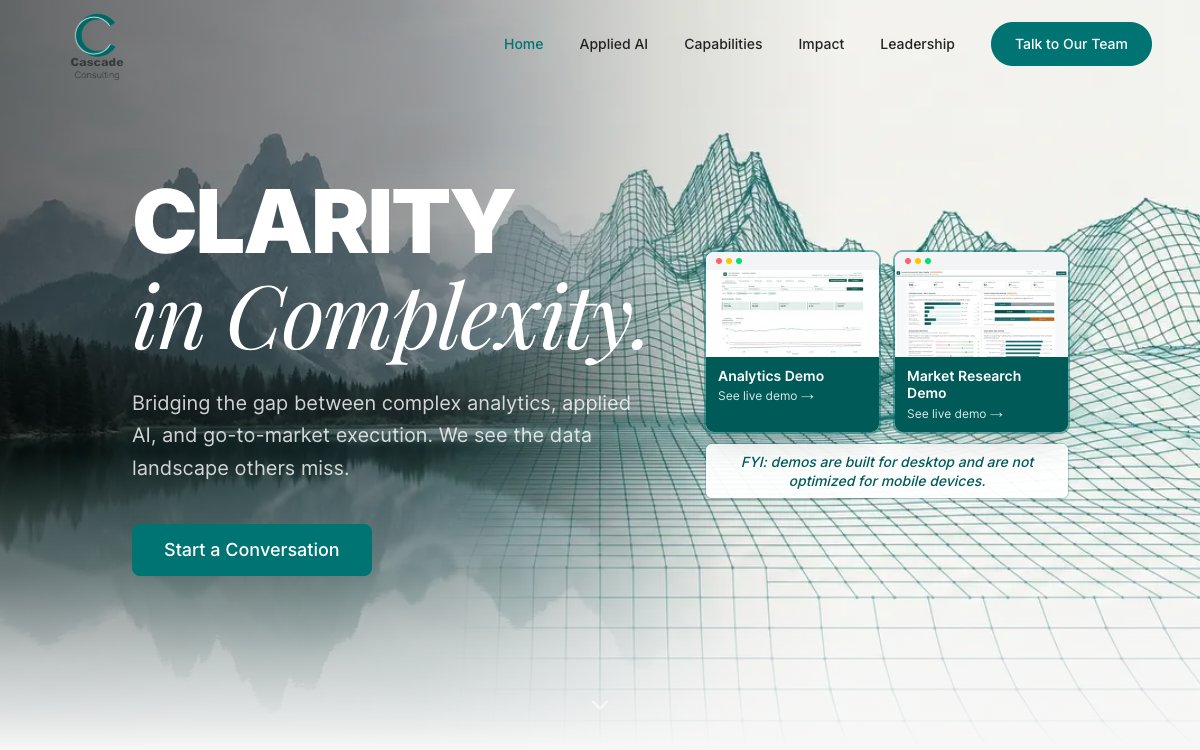
        Cascade Consulting websitecascadeconsultinggroup.org
        Cascade Consulting. A marketing site with its own visitor dashboard. The founder learned Claude Code and has since built a new page and his own dashboard without me.

        How it was built

        What the owners got

        • A working website, with the tools and guides to keep improving it.
        • Changes in plain English, with a preview before they go live.
        • Owners who keep building, including a new page and a dashboard made independently.

        How I built it

        1. Build around the business.

          Rachel needed an art portfolio and a shop. Cascade Consulting needed a marketing site and a way to see how visitors used it.

        2. Connect the working parts.

          The website, code history, hosting and analytics work together. The owners get guides for those same tools.

        3. Write the next-change guide.

          The maintenance guides turn common updates into plain-English requests. Each request names the page or content it should change.

        4. Put the tools in their hands.

          Rachel learned Cursor. The Cascade team learned Claude Code, connected to GitHub, Vercel and Supabase. Rachel went on to manage her site, and Cascade’s founder built another page and his own dashboard without me.

        Free workshops

        I also volunteered at free AI Build Club workshops in Washington, DC, helping people build their first website with AI. aibuildclubdc.com

        The handoff is part of the build.

        A working system is only half the job. The person using it needs to know how to run it and make it their own.

        “He has a simple way of explaining complex topics.” Colleen Krieger, founder, SuperBloom Strategies

        Move the control to the client. Watch who runs the next task.

        JaredThe client

        Jared runs the task. The client watches.

        1. I do. Jared drives. Build a working example together. Explain the context, the decisions and the points where a person checks the output. The client watches and asks questions.
        2. We do. We work together. Run the process together and document it. Work through the questions while the person using it is at the controls. The client tries it with support.
        3. You do. The client drives. Hand over ownership. The client runs the process and knows where to find the instructions. The documentation supports the handoff.

        From analytics to operations to building AI with teams.

        Understand the data. Learn how operations run. Then build with the people who use it.

        University of Virginia, BA Cognitive Science and BA Psychology, May 2017. Spanish: professional working proficiency. Portuguese: basic conversational.

        1. Aug 2017 to Feb 2022. McLean, Virginia.

          Capital One

          Analytics, product and risk.

          What I did at this stage

          Analyst, then Senior Analyst, then Business Manager. I owned yield-management analytics for the largest card segment and built the fee and interest models behind a $40 million credit decision. I automated leadership dashboards in Databricks and Tableau with SQL, Python and Spark, launched a financial-hardship relief partnership during COVID, and ran A/B tests for a mobile app feature.

        2. Mar 2022 to Feb 2023. Colombia, Peru, Bolivia, Argentina, Brazil.

          South America

          Teaching, travel and Spanish.

          What I did at this stage

          I taught English and volunteered in hostels, and reached professional working proficiency in Spanish.

        3. Mar 2023 to May 2025. Washington, DC.

          Hospitality startup research

          Running a hostel. The first AI builds.

          What I did at this stage

          I researched the hostel business from the inside to inform a go or no-go on a startup investment, working up to general manager of a 400+ capacity, 40+ staff operation. I built a web scraper with early ChatGPT, Playwright and Selenium to track hostel occupancy by city. It informed a no-go decision.

        4. May 2025 to present. Remote and Arlington, Virginia.

          Now

          Two consulting roles, side by side.

          Global pharma company

          AI Enablement Consultant (Contractor)

          Jun 2026 to present

          Dashboards for each role, governed AI answers and reusable AI skills for the commercial analytics teams, ahead of a drug launch.

          OtterMatic

          Founder & AI Systems Builder

          May 2025 to present

          Custom AI workspaces for professional-services firms, training the people who run them, and products like ClientMine and instantAIpage.

        What I can do, with the work that shows it.

        Build the system

        Make it trustworthy

        Where it came from

        The toolbox

        The specific tools, for anyone checking the list: Claude Code (custom skills, hooks, MCP tool connections), OpenAI and Gemini APIs, Zapier, Google Apps Script, Make.com, n8n, Playwright, Selenium, Python, SQL, Next.js and React, Supabase, Vercel, Snowflake, Tableau, Notion.

        Let’s build your team’s next chapter.

        Hiring for AI enablement? I’m looking for a full-time role or a contract where I build with your team and help them take over.

        Three ways to work with me: an AI enablement role on your team, an embedded consulting contract, or a defined build with training for your staff.

        jaredlschulman@gmail.com
        Jared Schulman
        How this portfolio was built
        How it works
        The demos on these pages run in your browser, written in TypeScript with SVG and Canvas. One small helper handles the spring motion and the puck. Approval pucks work with a click, Enter or Space. Sliders also work with the arrow keys. Reduced-motion settings are respected, and the pages still read with JavaScript off.
        What the demos are
        Simplified versions of the real systems. They send nothing and save nothing.

        Jared Schulman, Arlington, Virginia. No tracking, no cookies.